
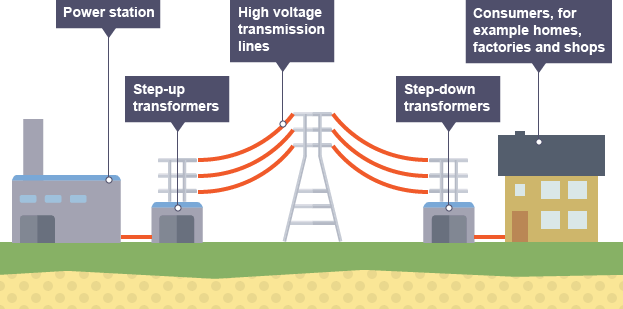
Let’s simplify the explanation for a GCSE level.
A step-up transformer is a device used in the electricity grid to make it work better. It does this in a few ways:
- Voltage Increase: The transformer increases the voltage of the electricity. Voltage is like the “push” that makes electricity flow. When we increase the voltage, we can use thinner wires to carry the electricity over long distances.
- Less Energy Loss: Thinner wires mean less energy is lost as heat. This is because the electricity encounters less resistance in the wires. So, the electricity reaches its destination more efficiently.
- Safe and Reliable: By increasing the voltage, we can keep the electricity safe and stable as it travels through the grid. This helps protect our devices and appliances from damage.
- Using Renewable Energy: Step-up transformers allow us to connect power sources like wind farms and solar panels to the grid, even if they are far away from where people use the electricity.
In simple terms, step-up transformers help make sure electricity travels efficiently, safely, and reliably through the grid, making it more useful for all of us.

Detailed Technical Explanation:
A step-up transformer plays a crucial role in increasing the efficiency of the national grid in several ways. The national grid is a complex network of power generation, transmission, and distribution systems that supply electricity to homes and industries. Transformers are essential components in this system, and step-up transformers are specifically used to increase the voltage level for long-distance transmission. Here’s how they enhance the efficiency of the grid:
- Voltage Transformation: Step-up transformers increase the voltage of electricity generated at power plants before it is transmitted through power lines. When voltage is increased, current decreases for the same amount of power, which reduces energy losses during transmission. The relationship between voltage (V), current (I), and power (P) is given by the formula P = V * I. By increasing the voltage, the current is reduced, and I²R losses (resistive losses) in the transmission lines are minimized. Lower current also reduces the heat generated in the wires, making the transmission more efficient.
- Reduced Line Losses: The power loss in electrical transmission lines is directly proportional to the square of the current (Ploss ∝ I²). Lower current, achieved by using step-up transformers, results in significantly lower line losses, improving the overall efficiency of the grid. These losses are primarily due to the resistance of the transmission lines, and reducing current helps mitigate these losses.
- Long-Distance Transmission: High-voltage transmission reduces the need for very thick and heavy conductors to transmit power over long distances. This not only reduces material costs but also makes the infrastructure more manageable and cost-effective.
- Voltage Stability: Step-up transformers help maintain voltage stability in the grid by regulating and ensuring that voltage levels remain within an acceptable range. Stable voltages are essential to prevent damage to electrical equipment and ensure the reliability of the power supply.
- Integration of Diverse Energy Sources: Power plants can be located far from population centers where electricity is needed. Step-up transformers allow energy generated at remote locations (e.g., hydroelectric dams, wind farms, or solar farms) to be efficiently integrated into the national grid for widespread distribution.
- Grid Flexibility: Step-up transformers provide flexibility in managing the flow of electricity within the grid. They can be adjusted to meet changing demand and load patterns, helping to optimize the distribution of electrical power.
- Grid Expansion: As the demand for electricity increases, the grid may need to be expanded. Step-up transformers facilitate the expansion process by connecting new power generation sources to the existing grid.
In summary, step-up transformers are a critical component of the national grid, as they enable efficient long-distance transmission of electricity while reducing energy losses, which ultimately enhances the overall efficiency of the grid and helps deliver electricity reliably to end-users.

 Akaal Classes - Young & Intelligent
You must be logged in to post a comment.